
Diamond Color, Cut, Clarity and Carat
Four C’s – How to measure diamond quality and price

1) Diamond Color
Diamonds are graded for color on a scale of “D” or colorless, to “Z” (Yellow). Beyond “Z”, they are considered to be an exotic or “Fancy” color. Diamonds may be virtually any color, those with “white” or colorless features are most in demand and greater in value. The significance of a diamond’s color on the stone’s price is an important factor. Several grading systems exist, but the most accurate involves use of a reflectance spectrophotometer. This instrument eliminates opinion and is able to measure color with plus-or-minus 3 accuracy on a scale of 10.000 units. Many experts name color as their number one consideration.
Diamond Color Scale
D | E | F | G | H | I | J | K | L | M | N | O | P | Q | R | S | T | U | V | W | X | Y | Z |
Colorless | NearColorless | Faint Yellow | Very Light Yellow | Light Yellow | ||||||||||||||||||
D | E | F | G | H | I | J | K | L | M | N | O | P | Q | R | S | T | U | V | W | X | Y | Z |
Colorless | Near Colorless | Faint Yellow | Very Light Yellow | Light Yellow | ||||||||||||||||||
Color chart for informational purposes only and do not represent actual color.
2) Diamond Clarity
Diamonds are graded according to their degree of clarity. All diamonds have identifying characteristics, but most are invisible to the naked eye. To view, experts use a 10x magnifying loupe which allows them to see the appearance of tiny crystals, feathers or clouds. These are called inclusions. There are five categories that you should be aware of when grading clarity.
Diamond Clarity Scale
FL | IF | VVS1 | VVS2 | VS1 | VS2 | SI1 | SI2 | I1 | I2 | I3 |
Flawless- | Very Very Slightly | Very Slightly | Slightly Imperfect | Imperfect | ||||||
FL (Flawless) – IF (Internally Flawless)
Flawless Diamonds reveal no flaws on the surface or internally are the rarest and most beautiful gems.
Internally Flawless Diamonds reveal no inclusions and only insignificant blemishes on the surface under 10x magnification.
VVS1 – VVS2 (Very, Very Slightly Included)
Very difficult to see inclusions under 10x magnification. These are excellent quality diamonds.
VS1 – VS2 (Very Slightly Included)
Only looking through a 10X loupe can pinpoint the inclusions in this category and are nearly impossible to see with the naked eye. These are less expensive than the VVS1 or VVS2 grades.
SI1 – SI3 (Slightly Included)
Diamonds with inclusions easily identified under 10x magnification. Finding flaws in this category with the naked eye is difficult. The gems in this category maintain their integrity, depending on the location of the inclusions.
I1 – I3 (Included)
Diamonds with inclusions which may or may not be easily seen by the naked eye. The flaws on the stones in this category will have some effect on the brilliance.
3) Diamond Cut
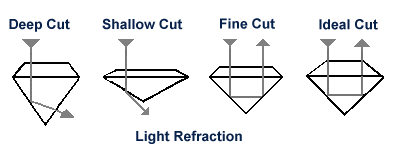
Cut refers to two things: the shape of the diamond and the proportions of the faceted stone. Diamonds may be cut in many shapes; round, oval, marquise, pear, emerald, and heart to name a few. The round brilliant cut is the most popular. The cut is proportioned with mathematical precision. Any noticeable deviation from proper proportions will affect the diamond’s brilliance (its fire), as well as price. The cut will determine how light is refracted back out and this will determine the fire and brilliance of the stone. A well cut diamond refracts nearly all the light entering it out of the top (crown) and sides.
4) Diamond Carat Weight
Diamonds are weighed with exact precision, using the metric carat system. One carat is the equivalent of 200 milligrams. This adopted measure of weight calls for each carat to be subdivided into 100 “points” (one carat equals l/5th of one gram, or 1/142 of one ounce.) Carat is often confused with size, even though it is a measure of weight. The cut can make a diamond appear larger or smaller than its actual weight. Larger diamonds are rarer and if all other characteristics are equal, the larger stone will command the greater price.
Glossary of Terms
| Brilliance: | White light captured from all the surfaces of the diamond and reflected up through the top. A diamond with the correct proportions yields the highest brilliance. |
| Brilliant Cut: | A brilliant cut has triangular facets that surround the stone that culminate on a flat top. A brilliant cut can be round, marquise, oval, pear-shaped, heart-shaped, princess (square), or radiant. |
| Carat Weight: | A unit of weight equivalent to 200 milligrams. |
| Carbons: | A flaw on the surface of a diamond that looks like a very small black dot. |
| Clarity: | Describes the number and extent of flaws that a diamond may have. Clarity is graded on a scale that ranges from Flawless (FL) to Imperfect (I3). |
| Cloud: | Hazy areas within the diamond actually made up of many small crystals that are impossible to see individually. |
| Color: | Describes the “yellowness” of a stone. The color scale ranges from D (colorless) to Z (deep yellow) |
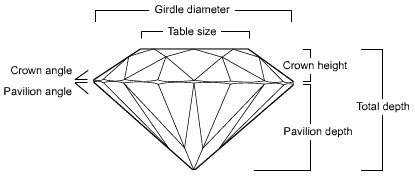
| Crown: | The top portion of a diamond, from the girdle (the thickest part around the stone) to the table (the top surface facing the viewer). |
| Crystal Growth: | A small crystalline growth within the diamond. Looks like a small diamond within the big diamond. |
| Culet: | The bottom “tip” of the diamond, where the facets of the pavilion converge. |
| Cut: | Perhaps one of the most misused of the 4 C’s, it refers to the style of cut (brilliant, emerald), the shape of the stone (round, heart-shaped), and the geometric proportions to which it is cut. |
| Cut Style: | Refers to whether a stone is a “brilliant cut” or an “emerald cut,” or a hybrid of the two. |
| Depth: | The height of a diamond, measured from the culet to the table. |
| Depth Percentage (%): | The height of a diamond divided by the width. The depth percentage is one of the many metrics used to measure how well proportioned a diamond is cut, and consequently how much “sparkle” it will have. |
| Emerald Cut: | An emerald cut is more “glassy” in appearance, since its facets usually span the length or width of the stone. Emerald cuts are different from step cuts in that their corners are rounded. |
| Facet: | The flat polished surfaces on a diamond. Brilliant cuts have 58 triangular facets and therefore “sparkle” more than emerald cuts, which have far fewer facets and therefore have a more “glassy, elegant” look. |
| Feathers: | Small cracks within the stone, similar in look to broken glass. Small internal feathers are harmless (other than lowering the clarity rating), but large feathers can become a problem because the crack can grow as the stone ages. |
| Fire: | When light is refracted within the diamond, the result is that multi-colored light beams out of the table, and it somewhat looks like fire. For maximum fire, seek out a well-proportioned stone. |
| Flaw: | A scratch or abrasion on the surface, or a defect within the crystalline surface of the diamond. The most common flaws are: Pinpoints, Carbons, Feathers, Clouds, and Crystal Growths. |
| Fluorescence: | A bluish glow within the diamond when exposed to ultraviolet light. Some people like fluorescence and some don’t. In any case, strong fluorescence should be avoided. |
| Girdle: | The narrow band around the width of the diamond, where the crown and pavilion meet. |
| Inclusion: | See Flaws |
| Pavilion: | The bottom portion of a diamond, from the girdle (the thickest part around the stone) to the culet (the tip at the bottom). |
| Pinpoint: | A very small white dot on the surface of the stone. By far, the most common flaw. |
| Point: | A weight measure equal to 1/100th of a carat. So for example, a 3/4 carat diamond is a “75 point diamond.” |
| Polish: | The final smoothness of the surfaces of a diamond. An excellent polish will result in a lower-weight stone, so most diamond cutters will make tradeoffs. |
| Proportions: | The proportion of a stone will directly influence how much “brilliance” and “fire” it has. See “depth percentage” and refer to the tutorial for guidelines. |
| Shape: | Refers to the way that the stone is cut. Common shapes are: Round, marquise, oval, pear-shaped, heart-shaped, princess (square), and radiant (also square). |
| Sparkle: | The combination of brilliance and fire that emanates from the diamond. |
| Step Cut: | A step cut diamond is “glassy” in appearance, since its facets usually span the length or width of the stone. |
| Table: | The largest surface on a diamond, located on the top of the diamond facing the viewer. The table culminates the crown of the diamond. |
| Table Percentage (%): | The width of the table divided by the diameter of the diamond. The table percentage is one of the many metrics used to measure how well proportioned a diamond is cut, and consequently how much “sparkle” it will have. |
| Workmanship: | Refers to the overall finish, including the polish on the facets, the symmetry of facets with respect to each other, and the shape of the culet. |